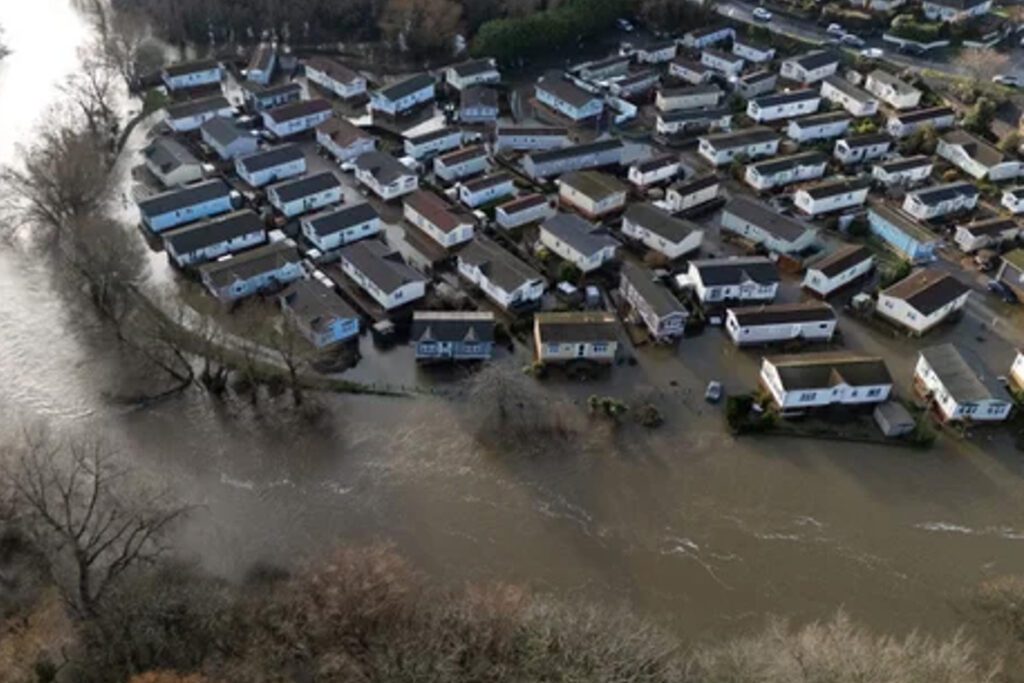
In 2014, it took two months for floodwaters to overwhelm the Somerset Levels.
This week, it took two days.
Rebecca Horsington, chair of a local flood action group, has watched the shift with growing unease.
“I recognise it,” she says. “The tension and anxiety are visible. Since 2014, the frequency of weather events has increased, and the rain just keeps coming down.”
What once felt exceptional now feels familiar.
Faster. Harder. Sooner.
Storm Chandra followed storms Goretti and Ingrid in quick succession, pounding the south-west with record 24-hour rainfall in Dorset, Devon and Cornwall. Homes flooded. Roads disappeared beneath water. Schools closed. Dozens were rescued from stranded vehicles.
The pattern is becoming harder to ignore.
Scientists warn that the kind of heavy winter rainfall climate models once projected for the 2040s is already arriving. Warmer air holds more moisture. When it releases that moisture, it does so in heavier bursts.
According to the Met Office, storms are now around 20% more intense than in previous decades. The past three years have been the hottest on record globally.
This is not simply more rain.
It is more water in less time.
Saturation
When soil is dry, it absorbs.
When it is saturated, it runs off.
Across much of the UK, the ground has reached that tipping point. Rivers that once rose slowly now surge rapidly. Drainage systems designed for twentieth-century weather patterns struggle to cope with twenty-first-century extremes.
Hydrologists describe it as a system under strain.
In Devon and Cornwall, steep valleys funnel water quickly from moorland to villages below. Coastal communities face rising sea levels as well as swollen rivers. Flash floods now strike areas previously considered safe.
Flooding no longer waits politely in low-lying plains.
It arrives wherever the ground cannot take more.
Designed for a Different Climate
Britain’s flood defences were largely designed for historical averages — predictable rainfall patterns, slower river responses, gradual accumulation.
That climate is shifting.
The question is no longer whether heavy rainfall will occur. It is how often, how intensely, and whether infrastructure can adapt quickly enough.
Some advocate natural solutions: planting trees to slow runoff, restoring wetlands, blocking upland drainage channels to reduce peak flows. Others emphasise hard defences — barriers, reinforced embankments, tidal gates.
All of them share the same premise:
Water must be managed before it overwhelms.
Learning to Live With It
For residents of repeatedly flooded communities, adaptation has become routine. Emergency bags are prepared. Sandbags are stored. Insurance battles are familiar.
“We’ve all been here before,” Horsington says. “But the weather events keep coming, and the rain keeps falling.”
The darker question is increasingly voiced aloud: if extreme rainfall becomes the norm, will some places become unviable?
Not because water is malicious.
But because systems designed for one era cannot absorb the load of another.
A Structural Shift
Water does not negotiate.
It follows gravity.
It follows volume.
It follows physics.
When conditions change, it reveals where systems are weakest.
The challenge facing Britain is not simply higher rainfall totals. It is the acceleration — the shortening gap between events, the reduced recovery time, the cumulative saturation.
Ground that never fully dries cannot prepare for the next storm.
Infrastructure that reacts cannot get ahead.
And communities caught between river and sea are forced into a new relationship with water — less about prevention, more about coexistence.
The Deeper Question
This is not just a funding debate or an engineering problem.
It is a design question.
How do you build systems — physical, social, economic — that allow water to move without causing collapse?
Because trying to hold back every surge is unrealistic.
But organising around it is possible.
Britain is entering an era where water is no longer occasional disruption.
It is a constant variable.
And the lesson is becoming clear:
When systems cannot absorb, they fail.
When they are designed to regulate, they endure.
Water is not the enemy.
But it does expose what was never built to cope with it.