For most of my adult life, I believed that forward motion equalled progress. Walking forward, training forward, pushing forward. Like many people who take pride in staying active through midlife, I assumed that consistency, effort, and experience would naturally keep my body balanced and resilient. I trained for decades, stayed disciplined, and remained physically capable by most conventional measures. Yet quietly, without drama or collapse, something fundamental began to change. My body didn’t lose strength or fitness. It lost symmetry. One side learned to dominate. The other learned to step aside. What I hadn’t lost was ability. What I had lost was organisation.
This is a reality rarely addressed in mainstream fitness or rehabilitation conversations. Most movement, whether on land or in water, is relentlessly forward focused. Walking, running, cycling, gym training, even most corrective exercise follows the same directional bias. Forward movement rewards efficiency and speed. It allows momentum to smooth over discrepancies and gives the stronger side permission to lead. Over time, this creates an illusion of competence. You feel capable, even powerful, while subtle compensations become deeply ingrained. The body adapts intelligently, protecting vulnerable joints by shifting responsibility elsewhere, often without conscious awareness.
When discomfort or injury appears, the advice is usually well intentioned and familiar. Keep moving. Stay active. Strengthen what you can. Avoid impact. On the surface, this makes sense. But in practice, it often strengthens the very compensations that caused the problem. What improves is not the quality of movement, but the efficiency of avoidance. The dominant side becomes more reliable. The weaker side becomes more disconnected. Activity continues, but balance erodes.
I reached a point where years of forward-driven training were no longer solving the underlying issue. Despite knowledge and experience, forward movement kept allowing me to bypass what wasn’t working. I wasn’t searching for a new workout or a harder challenge. I was searching for a way to move that removed the option to cheat. That search led me to something deceptively simple: walking backwards.
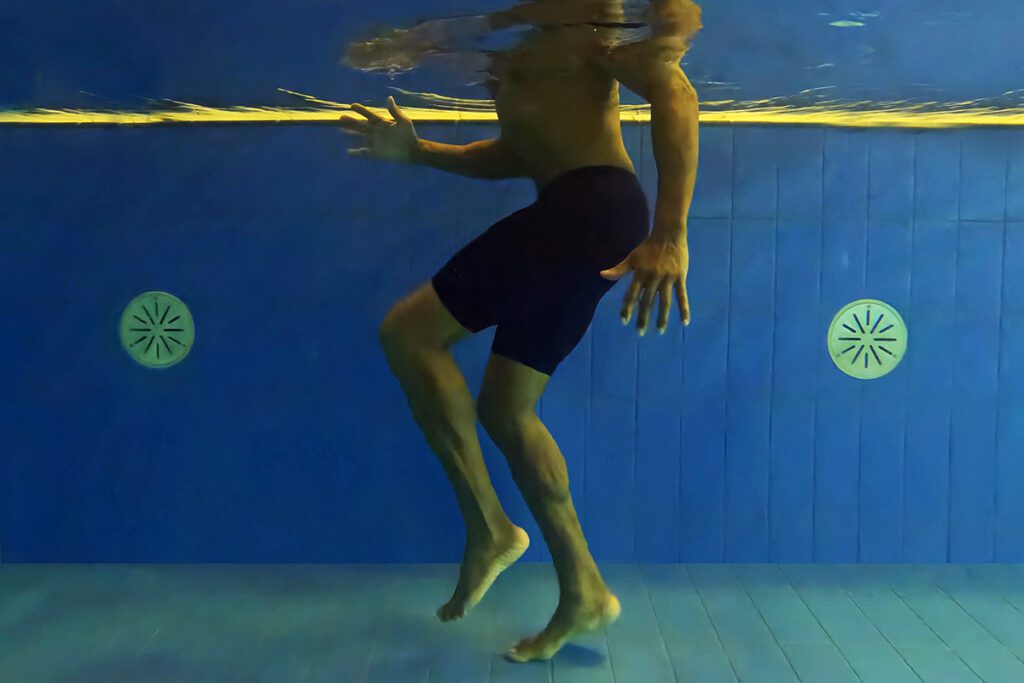
Reverse walking, particularly in water, changed everything not because it was difficult, but because it was honest. Walking backwards immediately stripped away momentum. It removed forward lean, reduced quadriceps dominance, and prevented speed from acting as a coping mechanism. The familiar shortcuts disappeared. The stronger side could no longer carry the weaker one. Each step demanded awareness, balance, and control rather than force.
What surprised me most was how quickly long-standing movement compensation became obvious. The standing foot had to engage properly. The hips had to remain level. The knee had to participate without being driven or protected. Movement slowed to a pace where the nervous system could no longer rely on habit. I wasn’t working harder. I was working with greater clarity.
In water, the effect of walking backwards is amplified. Buoyancy reduces joint compression, while resistance exists in every direction. Poor alignment is exposed instantly. There is no impact to absorb, but also no momentum to hide behind. The body must organise itself moment by moment. The question shifts away from strength and towards balance, from effort to coordination. Instead of asking how much the body can tolerate, reverse walking quietly asks how well the body is communicating with itself.
This is why walking backwards is not a novelty or a gimmick. It is correction. It changes the conversation between muscles, joints, and the nervous system. It brings the posterior chain back into relevance without force and restores bilateral contribution without instruction. Rather than exhausting the system, it recalibrates it. The body stops compensating and starts cooperating.
In midlife, this distinction becomes critical. Most people are not short on motivation or discipline. They are short on integration. Decades of forward-focused movement leave behind patterns that feel normal but no longer serve long-term balance or gait control. Traditional exercise often reinforces what already works well. Reverse walking challenges what has been quietly avoided.
Walking backwards fixed what years of training didn’t because it removed the assumption that forward is always better. It slowed movement enough to restore awareness. It changed direction just enough to reset coordination. It returned dignity to movement, not by adding complexity, but by removing disguise. Sometimes progress is not about pushing harder or further forward. Sometimes progress begins by stepping back and allowing the body to remember how to organise itself properly again. When that happens, strength and fitness stop compensating and start working together, and movement begins to feel intelligent rather than effortful once more.