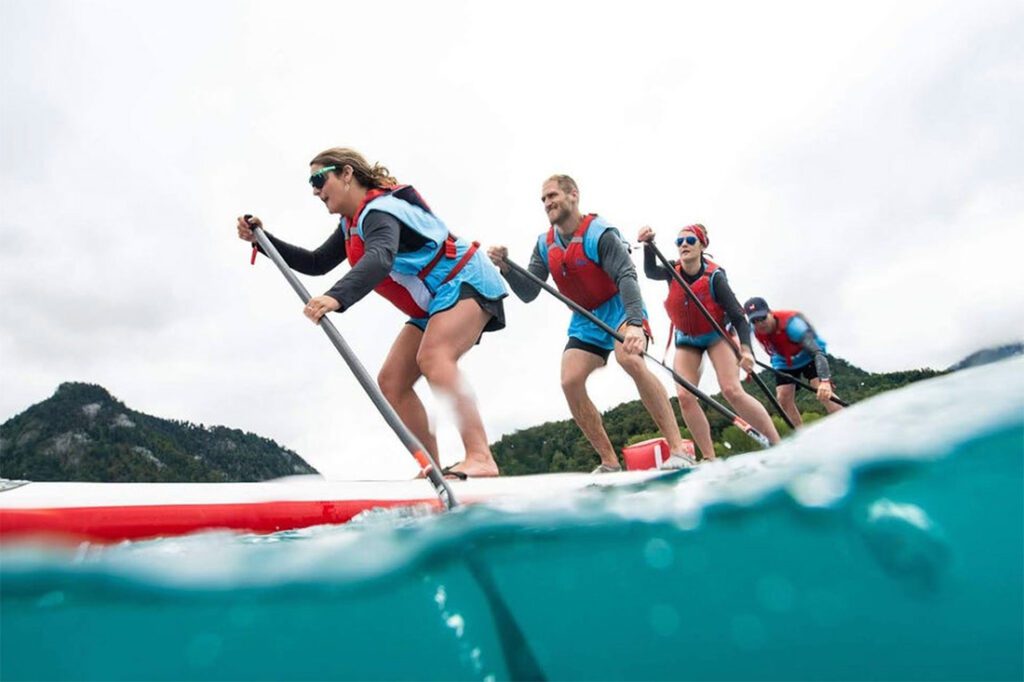
SUP (Stand-Up Paddleboarding) is a full-body workout with scientifically proven health benefits. When your training hits a rut, sometimes your best option might be to hit the water.
Whether you’re gliding calmly along a tree-lined river, tackling the open waves or hugging the coast on a SUP safari, stand or tackling ocean waves,-up paddle boarding allows you to immerse yourself in nature while getting a whole-body workout in at the same time.
SUP Safety
For beginners, getting the right kit is key. Choosing the right board according to your weight and the style of paddling you intend to do is also key. You also need a few accessories—a leash to keep you connected to the board, a flotation device, and a waterproof pouch for safety.
Remember to check the route and weather conditions before setting off. Be aware of tides and currents at coastal locations, underwater obstructions, and nesting wildlife on rivers—your local SUP club can keep you updated on local conditions.
If you’re heading out alone, ensure someone knows when you’ll be back. Once you’ve taken care of the basics, hit the water and enjoy the glide.
5 Benefits Of Stand-Up Paddleboarding
1. Better Balance
SUP acts like a wobble board, constantly challenging balance and working the tiny stabilising muscles in your legs, feet and arms with a minimum risk of injury.
• A fantastic midlifer activity was found in a 2018 study published in The Journal of Sports Science & Medicine, which found that balance training enhances postural stability and reduces the risk of falls, particularly in older adults.
2. Core Strength
You’d be forgiven for thinking your arms do most of the work when you’re paddleboarding, but your core is responsible for your momentum through the water. Each stroke you take is like a mini-crunch for your abs – although it depends on the correct technique.
Stand with your feet shoulder-width apart and your knees flexed. With one hand on the T-grip (the top of the pole) and the other on the shaft, place the paddle in the water at arm’s length and draw it alongside your board, keeping the blade perpendicular.
• A 2020 study in The Journal of Strength and Conditioning Research highlighted that stand-up paddleboarding activates the rectus abdominis, obliques, and deep core muscles.
3. Peace of Mind
Like green spaces, ‘blue spaces’ (lakes, rivers, and oceans) support mental health and well-being
• A 2019 study in Environmental Research found that exposure to ‘blue spaces’ (oceans, lakes, and rivers) reduces stress, improves mood, and enhances social connectedness. Another study at the University of Virginia found that spending time in a blue space can make you happier, reduce stress, improve your quality of life, and make you more sociable and altruistic.
4. Something for Everyone
There’s a SUP style for every personality and fitness goal. First-timers will do well with an ‘all-round’: thick, multipurpose boards that are wide and long to increase stability.
They’re suitable for river and ocean touring but still versatile enough for surfing if you don’t want to get a dedicated surf paddleboard. Some all-round boards have a mast foot fitting, so you can attach a windsurf-sailing rig, too.
• A 2021 study in Sports Medicine emphasised that cross-training with low-impact water sports like paddleboarding improves cardiovascular endurance, flexibility, and muscular strength while minimising joint strain.
5. Fat Burn
If you want to torch fat, SUP could be the way to go, burning up to 1,125 calories in an hour of high-intensity racing.
• Research in The Journal of Applied Physiology suggests that water-based exercise enhances circulation and heart function by reducing vascular resistance.