Water rarely announces itself.
It flows.
It nourishes.
It sustains quietly.
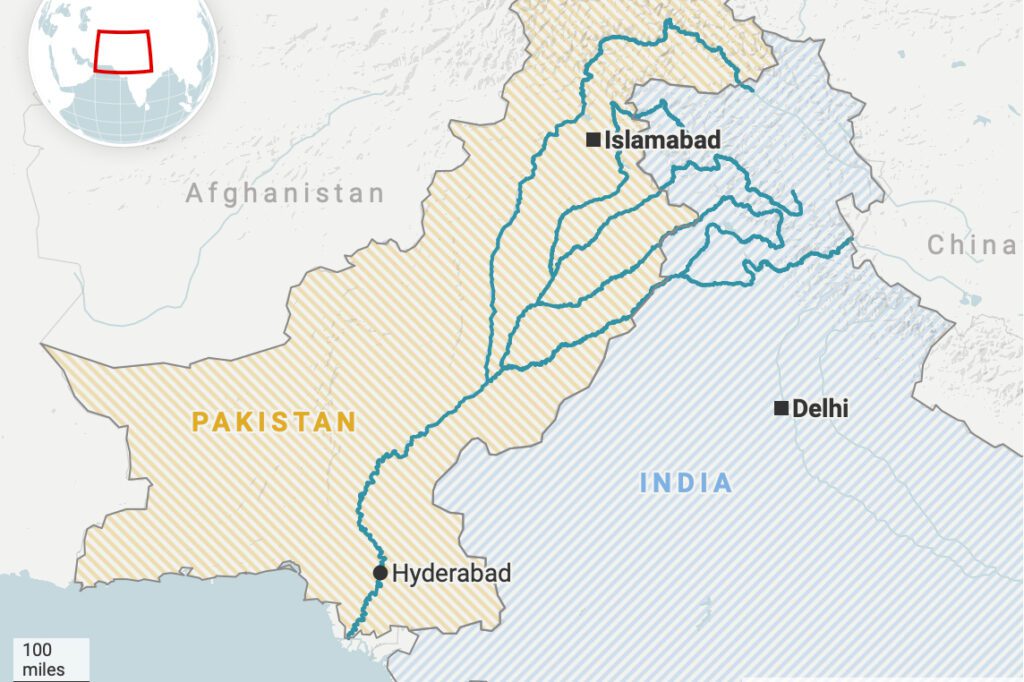
For more than sixty years, the Indus river system has done exactly that — moving from the Himalayas through India into Pakistan, supporting millions along the way. Through wars in 1965, 1971 and 1999. Through political rupture and decades of distrust.
The water kept flowing.
That continuity was not accidental. It was structured.
The 1960 Indus Waters Treaty, mediated by the World Bank, divided six rivers between the two nuclear-armed rivals. The eastern rivers — Ravi, Beas and Sutlej — were granted to India. The western rivers — Indus, Jhelum and Chenab — were allocated to Pakistan, where they sustain more than 80% of irrigated agriculture.
Borders hardened. Diplomacy fractured.
The rivers continued.
Until now.
The Trigger
Gunfire shattered the calm near one of Kashmir’s most renowned beauty spots. Twenty-six Indian visitors were killed. Seventeen were injured. India accused Pakistan of backing the attackers. Troops exchanged fire along the fortified border.
Then something deeper shifted.
India placed the Indus Waters Treaty “in abeyance.”
No dams were closed.
No flows were halted.
But the language changed.
And language matters.
The Power of the Upstream
Water flows downhill.
Power flows upstream.
When rivers cross borders, geography becomes leverage. Upstream nations hold structural advantage. Downstream nations depend.
Pakistan depends absolutely. The Indus basin is not landscape — it is infrastructure. It is agriculture. It is survival.
Indian officials declared that water allocated to India would not be allowed to flow onward. Pakistan warned that any attempt to disrupt supply would be treated as an act of war.
Nothing has yet been diverted.
But even suggesting that agreements are conditional destabilises systems built on predictability.
The Fragility Beneath Stability
The treaty’s durability made it exceptional. It survived every Indo-Pakistani war. It endured when diplomacy elsewhere collapsed. It became a model for global water cooperation.
Its suspension matters not because war has begun — but because stability is no longer assumed.
Water, once politicised, becomes harder to keep neutral.
Some analysts argue India lacks the infrastructure to meaningfully restrict flows for many years. Others warn that even symbolic weaponisation of water signals a dangerous shift.
Both may be correct.
The greater risk is structural.
The Broader Chessboard
The Indus rivers rise in Himalayan glaciers — part of the world’s “water tower.” Those glaciers are shrinking. Seasonal flows are becoming less predictable. Populations are growing. Agriculture remains dependent on consistency.
Water tension rarely begins with scarcity alone.
It begins with uncertainty.
When supply becomes unstable, control becomes strategic.
And India is not the only upstream actor. Much of the Himalayan watershed lies in China — already constructing dams that concern New Delhi.
Water sits inside a wider geopolitical geometry.
Is War Imminent?
No.
There is no confirmed diversion of water. No declared water war. Most observers view the treaty suspension as political signalling following a deadly attack.
But signalling shifts perception.
And perception shifts behaviour.
When one of the world’s most resilient water treaties begins to fray, the lesson is not hysteria.
It is awareness.
Water is never just water.
It is infrastructure.
It is agriculture.
It is national identity.
It is survival.
A Structural Lesson
Water does not create instability.
It reveals it.
For six decades, the Indus Treaty acted as structure — a framework that allowed tension without collapse. When structure weakens, vulnerability surfaces.
At the level of nations, the consequences are geopolitical.
At the level of the body, they are physical.
A body can look strong and still over-rotate.
A nation can appear stable and still drift.
In both cases, breakdown rarely begins with violence.
It begins with subtle imbalance.
Water exposes what momentum disguises.
That is true in rivers.
And it is true in movement.
Water sustains.
Water stabilises.
And when it becomes leverage rather than structure, unpredictability follows.