Cardinham, Cornwall — Laura cannot remember the last time she hung washing outside.
Her children, Harriet and Rupert, have stopped asking. The garden is a bog. The dog returns mud-coloured every time. Inside, radiators are draped with clothes that never quite dry.
“Never has this house been so full of sopping wet clothes,” she says.
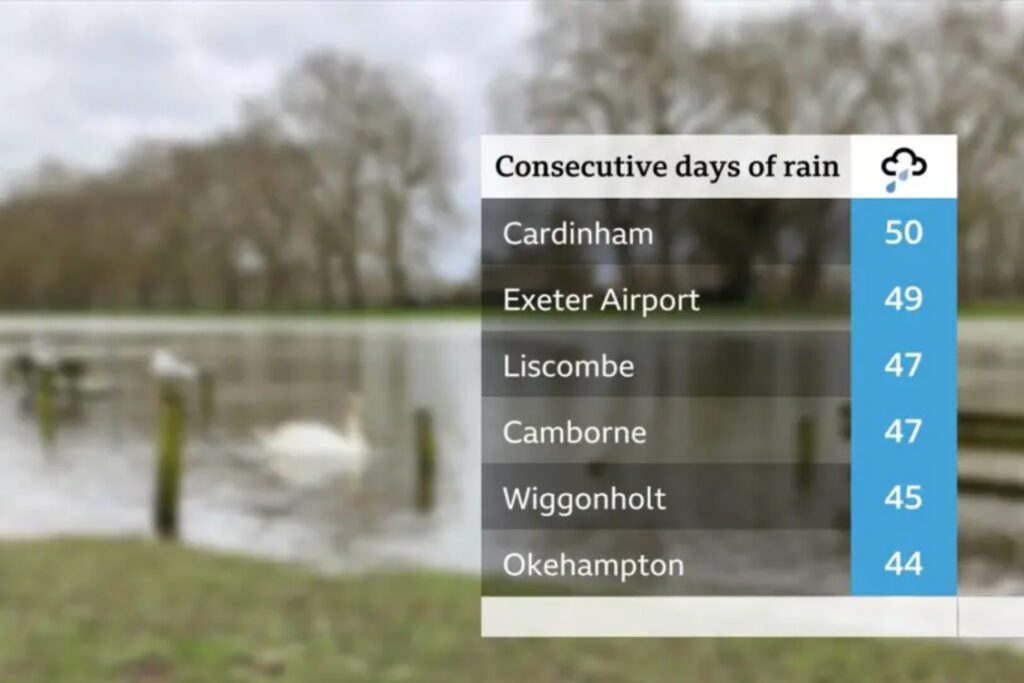
It has rained here every day since December 30th. Fifty days without a break.
The Met Office confirms what residents already feel in their bones: this is the longest wet spell Cardinham has seen since 2000, when rain fell for 72 consecutive days. They are not there yet. But February has already delivered more rainfall than usual, and the ground offers no comfort — only more mud.
Across the UK, the pattern repeats.
In parts of Devon and Cornwall, rain has fallen for more than six weeks without interruption. West Sussex has seen 45 consecutive wet days. In Northern Ireland, rainfall has reached two and a half times the February average. In Aberdeenshire, more than half a typical year’s rain has already fallen — and it is only February.
For parents, half-term has become an endurance test.
Will Palmer usually spends his days outside — walking his dog, riding his bike. Lately, he stays in.
“It’s miserable,” he says. “You just have to accept it.”
Why It Has Not Stopped
The science is straightforward, even if the weather is not.
After New Year, a vast area of high pressure settled over eastern and northern Europe, trapping cold air beneath it. To the west, a powerful Atlantic jet stream — fuelled by Arctic air spilling across North America — steered low-pressure systems directly into western Europe.
The high pressure blocked their path.
They stalled.
And rained.
And kept raining.
Climate change loads the dice. A warmer atmosphere holds more moisture. When it rains now, it often rains harder. UK winters are becoming wetter, warmer, more insistent.
This is what that looks like on the ground: fields that never dry, rivers that never fall, families learning to live with damp.
Not everywhere has suffered equally. Parts of western Scotland and the north-west of England have seen below-average rainfall. Some Highland areas have gone weeks without a drop. The same blocked system that drowned the south and west shielded the north.
Weather is never fair.
A Brief Shift — Not a Break
This weekend, finally, something changes.
The blocked pattern is beginning to weaken. For the first time since December, low-pressure systems will be able to move more freely. Some parts of the UK may see temperatures reach 15 or 16 degrees — the first suggestion of spring.
But warmth does not mean dry.
South-westerly winds will continue to bring rain, just distributed differently. Western hills may see more. Other areas may catch brief, precious intervals of sun.
The Met Office remains cautious. No extended dry spell is forecast until at least mid-March. The ground is saturated. Rivers are high. Any rain that falls now does not soak in; it runs off, straight into already swollen waterways.
After the drought of 2025 — after months of exceptional dryness — the land has flipped. It cannot absorb more.
Living With It
For Laura, that broader context is distant.
She has two children, one dog, and a house full of wet clothes.
Harriet and Rupert still find it exciting — the puddles, the mud, the excuse to splash. Their mother smiles when she says it.
“You’ve got to get out there and do it.”
Fifty days of rain. Spring approaching. No true break yet in sight.
The washing will wait.
Because when water decides to stay, you do not fight it.
You adapt.
And in the end, adaptation is always the deeper story.