Luxury wellness retreats attract people who already move well.
Some arrive for yoga intensives. Others attend Pilates retreats or breathwork programmes. They are often disciplined practitioners, deeply familiar with their bodies and the subtle language of movement.
Which is why their reactions to water can be so interesting.
Last year while teaching on a Mediterranean retreat, a senior yoga teacher watched my small group moving slowly through the pool. She had spent years guiding students through standing poses and balance work on land. Alignment, posture and equilibrium were her daily vocabulary.
Eventually curiosity won.
She stepped into the water to try the movements herself.
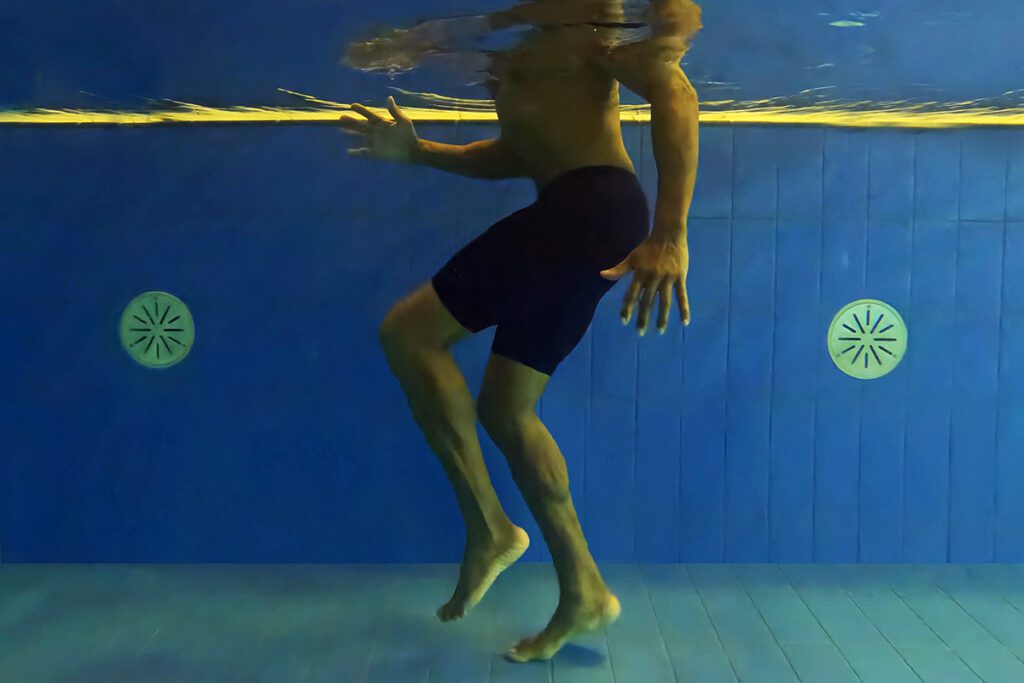
The exercise was simple: a controlled step forward followed by a deliberate pause. Nothing dramatic. No acrobatics. Just movement through the water and then stillness.
Within seconds she began to laugh.
“Why is this so much harder?” she asked.
“I teach balance on land every day.”
Her question was genuine. From the outside, the movement looked uncomplicated. Yet in the water she could feel something different happening inside the body. The balance she relied on in the yoga studio suddenly had to renegotiate itself.
The water had quietly changed the rules.
Later that week another visitor experienced a similar moment.
She was attending a Pilates retreat and had time between sessions. Curious about what was happening in the pool, she joined a class.
Like the yoga teacher, she was an experienced practitioner. Years of training had developed strong core awareness and controlled movement. Pilates had given her the ability to organise the body with precision.
Then came the pause.
The movement slowed, the body stopped, and the water began to speak.
Afterwards she reflected on what she had felt.
“I can literally feel the imbalance,” she said.
“And the weakness in my core. I’ve never felt it this clearly before.”
Her reaction was not frustration. It was fascination.
Two experienced practitioners.
Two different disciplines.
The same quiet discovery.
What they felt was not failure. It was honesty.
On land, the body can rely on the ground for stability. The floor offers a constant reference point. Even when standing on one leg, the nervous system knows exactly where support is coming from.
Water softens that certainty.
Buoyancy reduces compression through the joints. Resistance surrounds the body from every direction. Momentum fades quickly. Small shifts in posture create drag. The nervous system must reorganise balance within a less predictable environment.
On land, the body is remarkably good at hiding its small asymmetries. A dominant side quietly takes over. The pelvis rotates slightly. One shoulder lifts higher than the other. The movement still looks correct. The exercise is completed successfully.
Water removes that illusion.
Without momentum and without the same ground reference, the body cannot disguise subtle imbalances. The pause reveals how the body is actually organising itself in space.
For both practitioners, the discovery was not about replacing the disciplines they loved. Those practices had already given them awareness, strength and control.
Water simply asked a different question.
How does the body stabilise when the environment itself is moving?
That question surprised them both.
One had spent years teaching balance on land. The other believed she understood her core with great precision. Yet in the quiet moment of the pause, both felt something new — not because their training had failed them, but because the water revealed details that had never been so clear before.
This is the quiet gift of aquatic movement.
Water slows the body down.
It removes momentum.
It softens gravity’s dominance.
It surrounds the body with resistance from every direction.
In that environment, the body becomes more honest with itself.
Small asymmetries appear. Subtle imbalances become perceptible. Muscles that normally remain silent begin to participate in the conversation.
For experienced practitioners, that moment can feel surprisingly refreshing.
Not because it challenges what they already know.
But because it expands it.
In water, the body learns to listen again.