
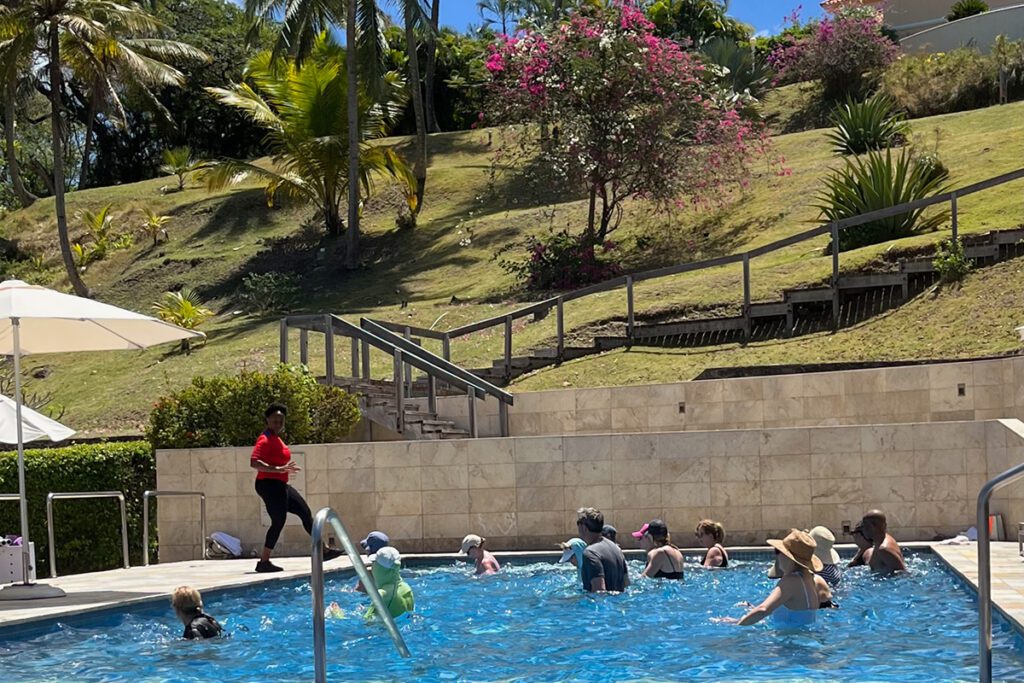
I recently stood at the side of a pool and watched an Aqua aerobics class unfold.
The atmosphere was good. Light. Social. The kind of energy that makes people feel comfortable the moment they step in. The instructor moved with confidence, playing to the group, drawing them in. There was laughter, rhythm, a sense of shared participation. You could see why people come back.
And that matters. Because for many, just getting into the water is already a step forward.
But as I watched more closely, something else began to surface.
Beneath the music and the movement, there was very little conversation happening with the body itself. Movements were repeated, not explored. Arms and legs moved through patterns, but without real attention to alignment, controlled stabilisation, or what was actually supporting the motion beneath the surface.
There was activity—but not awareness.
Years ago, I would have missed that distinction completely. I would have seen the movement, the energy, the effort, and assumed that was enough. In many ways, I was like that myself—moving, training, doing what was asked, without always listening closely to what my body was trying to tell me.
That changed when injury slowed me down and water stopped being a backdrop for exercise and became something else entirely. Over time, through what I now call KunAqua, I began to understand that water is not just a place to move. It is a place that reveals how you move.
And in water, that distinction becomes everything.
Because water is not just a softer version of land training. It is a completely different environment. One that, when used properly, exposes things most people have spent years unknowingly hiding. Imbalance. Compensation. Disconnection. The shortcuts the body takes when nobody has taught it another way.
I’ve seen it in something as simple as a step forward through the water. On the surface, it looks like a basic movement. But slow it down and the truth appears. You feel where the knee collapses inwards, where the hip avoids loading, where balance is being borrowed instead of built. The movement is still small. But the information inside it becomes enormous.
That is what water offers when you let it.
Not just resistance, but feedback.
Its support is always there, but never enough to rescue poor mechanics. Its resistance is constant, but never aggressive. It slows the body down just enough for you to notice where you are unstable, where range has been shortened by habit, and where control has been replaced by momentum.
That is the difference.
One approach uses water as a backdrop—something to make movement easier, lighter, more entertaining. The other uses it as something else entirely.
There’s also a reason classes like this are everywhere.
They’re accessible. Easy to follow. Easy to deliver. In many wellness resorts and gyms, aquarobics is one of the most practical formats to run. A basic Level 2 Exercise to Music qualification is enough to lead a class, and participation is limited only by the size of the pool. Almost anyone can take part, regardless of age or fitness level.
And that accessibility matters.
Because getting people moving—especially in midlife—is no small thing.
But accessibility and depth are not the same.
One helps people enjoy movement.
The other teaches them how to understand it.
That is the part that still gets missed. People can spend years in the pool and never really meet the water. They complete the class, follow the rhythm, enjoy the session, and leave believing they have trained in water. But often they have only performed in it.
Real water training asks more of you. It asks you to feel where one side takes over. To notice when alignment slips. To move slowly enough for the body to tell the truth.
It is less performative. Sometimes less exciting to watch. But far more revealing to do.
And over time, that changes everything—not just how you move in water, but how you stand, step, stabilise, and recover on land.
That is the territory KunAqua was built from. Not from spectacle, but from listening. Not from trying to overpower the body, but from learning how to work with it.
Because over time, I came to understand something simple.
Water isn’t just something you use.
It’s something that teaches you—if you’re willing to listen.